# Living Statues
**Follow the story of the moai, from the ceremonial platforms they stood upon to the quarry where they were born.**
The moai are the most recognizable symbols of Rapa Nui, but their story goes far beyond the statues themselves. *Living Statues* is a full-day journey into the island's extraordinary megalithic culture, exploring how these monuments were built, what they represented, and how they became one of the greatest achievements of ancient Polynesia.
Through a carefully selected route along the southern and eastern coast of Rapa Nui, this experience follows the evolution of the moai era through ceremonial platforms, ancient settlements, fallen statues, and the volcanic quarry where nearly all moai were carved.
Your journey begins at **Vinapu**, one of the island's most remarkable archaeological complexes. Its carefully fitted stonework offers an impressive introduction to the engineering and craftsmanship behind the ahu — the ceremonial platforms that formed the center of ancient communities and upon which the moai once stood.
From there, we continue along the southern coast to **Vaihu (Hanga Te'e)**, where fallen moai remain exactly where they came down centuries ago. Here, the landscape provides an opportunity to understand the structure of a traditional ceremonial center, the relationship between the statues and their communities, and the dramatic changes that eventually brought the moai-building period to an end.
The story continues at **Akahanga**, one of Rapa Nui's largest archaeological complexes. Surrounded by the remains of ancient houses, ceremonial structures, and numerous fallen moai, Akahanga reveals how these monuments were integrated into everyday life. According to oral tradition, this area is also associated with Hotu Matu'a, the legendary founding ancestor of the Rapa Nui people.
We then arrive at **Rano Raraku**, the extraordinary volcanic quarry where nearly all of the island's moai were carved. Hundreds of statues remain scattered across its slopes in different stages of production and transportation, making it possible to observe how the moai were created directly from the volcanic rock. Walking among them is one of the most remarkable experiences on Rapa Nui — a place where the statues seem to emerge from the mountain itself.
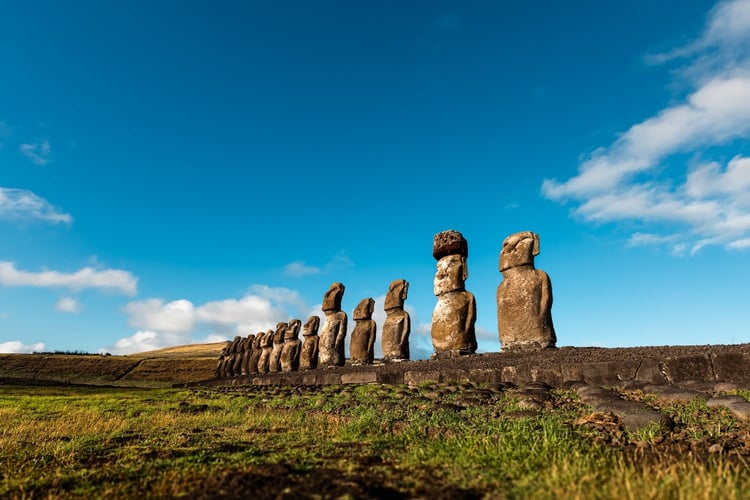
The journey culminates at **Ahu Tongariki**, the largest restored ceremonial platform on the island. Its fifteen standing moai create one of Rapa Nui's most iconic landscapes and offer the perfect conclusion to the story. After exploring the quarries where the statues were created, Tongariki allows us to see the final result of that extraordinary process: the moai standing together on their ahu, facing the land and watching over the communities they represented.
More than a tour of archaeological sites, *Living Statues* is an exploration of the people behind the monuments. Along the way, you will discover how the moai were carved and transported, why they were erected, what the ahu represented, and how ancestor worship shaped the landscape and society of ancient Rapa Nui.
Designed for travelers who want to understand the moai beyond the photographs, *Living Statues* combines archaeology, history, oral traditions, and spectacular landscapes to reveal the human story behind the island's most extraordinary monuments.
### Highlights
* Discover the history and meaning behind Rapa Nui's famous moai
* Follow the evolution of the island's extraordinary megalithic culture
* Explore ancient ceremonial platforms, settlements, and fallen statues
* Walk through Rano Raraku, the volcanic quarry where nearly all moai were carved
* Visit Ahu Tongariki and its iconic row of fifteen standing moai
* Learn how the moai were carved, transported, erected, and connected to ancestor worship
* Enjoy a private experience with time to explore each site at a comfortable pace
### Sites Visited
* Vinapu
* Vaihu (Hanga Te'e)
* Akahanga
* Rano Raraku
* Ahu Tongariki


 English
 Trace ancient petroglyphs carved into Rapa Nui's volcanic rock — messages left in stone.
 Come face to face with the giants of Rano Raraku, still rising from the hillside where they were born.
 Where the moai fell, they stayed — read the silence of a fallen ceremonial center.
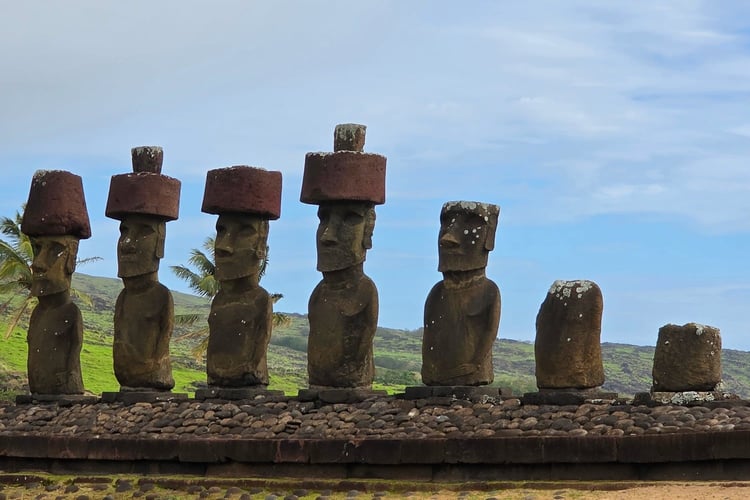
 A fallen pukao — the red topknot of a moai — resting at the coastal edge, tide just beyond.
 Discover the massive displaced stones of an ahu, each one a testament to what was built — and what fell.
 Stand beside Tongariki's fifteen giants and feel the scale of ancient Rapa Nui.
 At Rano Raraku, the moai dwarf everything — including you.


